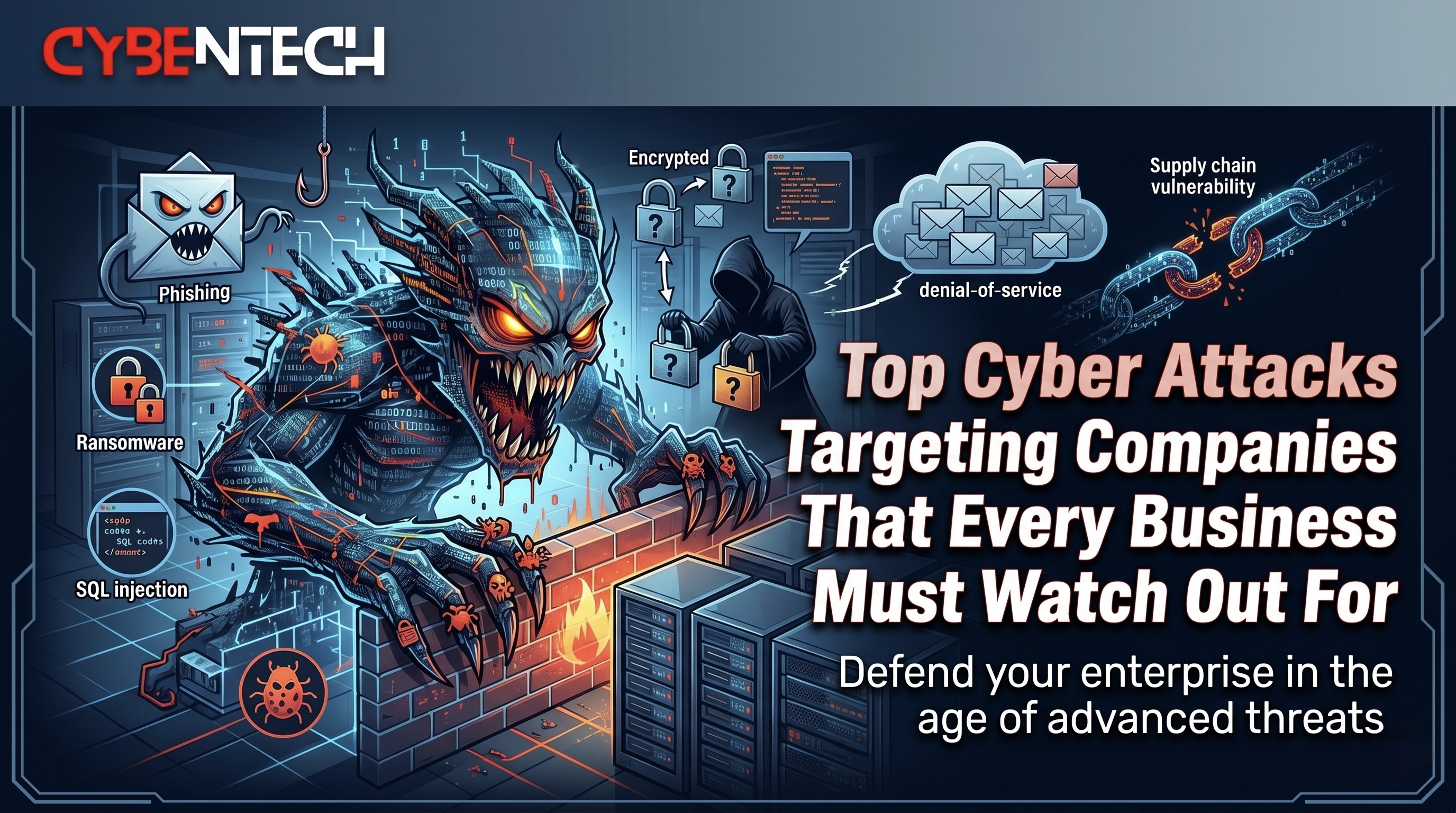
Top Cyber Attacks Targeting Companies That Every Business Must Watch Out For
Cyber attacks against companies are rising every year. This article explains...
Read More
Digital transformation has made companies increasingly dependent on IT systems, cloud platforms, web applications, and network connectivity. However, the greater the reliance on technology, the larger the attack surface available to cybercriminals.
Today, cyber attacks are no longer just an IT problem — they are a strategic business risk. Data breaches, operational downtime, and reputational damage can lead to massive financial losses.
This article explores the top cyber attacks targeting companies, how these attacks work, and how organizations should prepare their defenses.
Ransomware is a type of malware that encrypts company data and demands payment in exchange for restoring access.
Ransomware typically enters organizations through:
Once inside the network, the malware will:
Modern ransomware often steals data before encryption, increasing pressure on victims to pay.
Phishing is a psychological manipulation technique used to trick employees into revealing sensitive information or granting access.
Technology can be secured, but humans remain the weakest link.
Industry statistics show that over 80% of security breaches start with phishing.
An incident where sensitive information is accessed without authorization.
For digital businesses, data is a core asset. Losing data often means losing customers.
An attack that floods servers with fake traffic until services become unavailable.
DDoS attacks are often used for:
Not all attacks come from outside the organization. Insider threats can be more dangerous because insiders already have legitimate access.
Attacks that target vendors or third-party software used by a company.
Vendors often have:
If one vendor is compromised, attackers can infiltrate multiple companies simultaneously.
Supply chain attacks have increased significantly in recent years.
Web applications are primary targets because they are publicly accessible.
A compromised web application can allow attackers to:
Your website is often the front door of your business.
Cyber incidents create losses in multiple areas:
| Loss Category | Business Impact |
|---|---|
| Downtime | Revenue loss |
| Recovery | Forensics and restoration costs |
| Legal | Fines and lawsuits |
| Reputation | Customer churn |
| Operations | Business disruption |
Cybersecurity is now a business investment, not just an IT expense.
Never trust by default — even inside your network.
Employees must be trained to recognize phishing and social engineering.
Regular updates are critical to close security gaps.
Mandatory for all critical access points.
Use tools such as:
Preparation determines survival during a cyber incident.
Cyber attacks against companies continue to evolve in scale and sophistication. No organization is too small or too large to become a target.
Modern businesses must treat cybersecurity as a strategic priority integrated with operations.
Investing in cybersecurity today is far less expensive than recovering from a breach tomorrow.
Cyber attacks against companies are rising every year. This article explains...
Read More
Cyberattacks can devastate a company’s finances, operations, and brand trust....
Read More
Cyberattacks can lead to data breaches, operational disruptions, and...
Read More