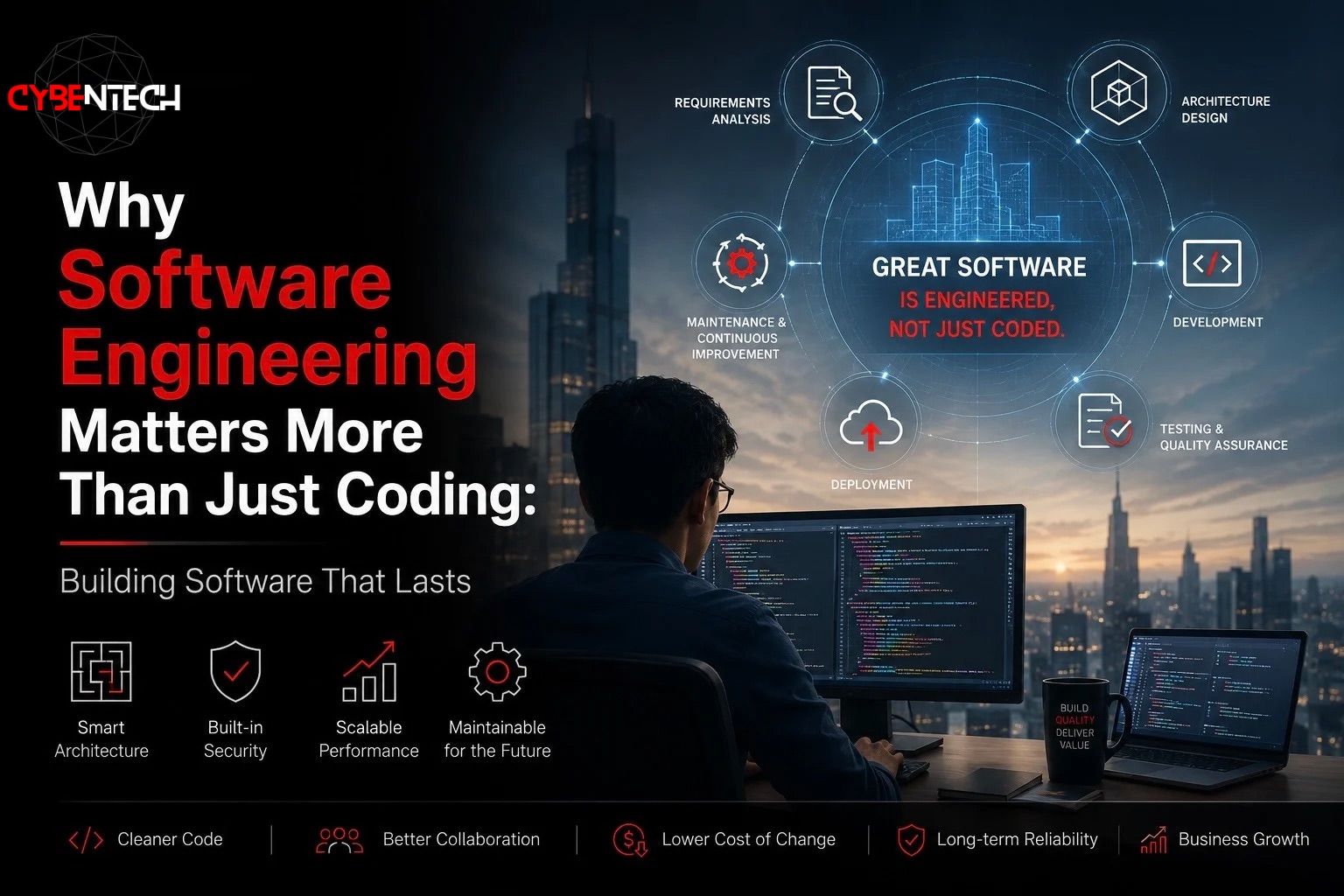
Why Software Engineering Matters More Than Just Coding: Building Software That Lasts
Writing code is only one part of creating successful software. True software...
Read More
In today's fast-moving digital landscape, software has become the foundation of modern businesses. From enterprise platforms and e-commerce systems to financial services and manufacturing operations, organizations rely on software to drive productivity, improve customer experiences, and accelerate innovation.
Yet many people still believe that software development is simply about writing code.
The truth is, coding is only one component of software engineering.
While coding focuses on implementing features, software engineering is the discipline of designing, building, testing, deploying, maintaining, and continuously improving software systems throughout their entire lifecycle. Businesses that recognize this distinction are more likely to invest in software solutions that remain reliable, scalable, and maintainable for years—not just months.
Think of constructing a skyscraper.
Writing code is similar to laying bricks. Every brick matters, but without architectural planning, structural calculations, engineering standards, and quality assurance, the building will eventually become unstable.
Software engineering provides the framework that transforms individual lines of code into dependable business systems.
| Coding | Software Engineering |
|---|---|
| Focuses on writing features | Focuses on the complete software lifecycle |
| Solves immediate technical problems | Solves long-term business challenges |
| Individual implementation | Team collaboration and engineering processes |
| Produces working code | Produces reliable, scalable software products |
| Limited documentation | Comprehensive documentation and governance |
Professional software development is never just about making an application "work." It is about ensuring that the application continues to work efficiently as users, data, and business requirements evolve.
Businesses often view software as a one-time project. In reality, software is a long-term business asset.
A professionally engineered application should continue delivering value through:
Without proper engineering practices, every future update becomes increasingly expensive and risky.
Well-engineered software reduces technical debt, minimizes maintenance costs, and extends the lifespan of the entire system.
One of the defining characteristics of software engineering is software architecture.
Before writing the first line of code, experienced engineers design how every component will interact, communicate, and scale.
Key architectural considerations include:
A strong architecture enables businesses to introduce new features without rebuilding the entire application.
Instead of constantly fixing structural issues, development teams can focus on delivering innovation.
Fast development may look impressive during the first few weeks of a project.
However, the real challenge begins after deployment.
Can another developer understand the code?
Can new features be added safely?
Can bugs be fixed quickly?
Can the application evolve alongside business growth?
Software engineering emphasizes maintainability through:
Maintainable software reduces downtime, shortens development cycles, and lowers operational costs throughout the application's lifecycle.
Many applications perform well with hundreds of users.
Far fewer continue performing well with thousands—or even millions.
Scalability is not something that can simply be added after launch.
It must be considered from the beginning.
Professional software engineering addresses scalability through:
When businesses grow, their software should grow with them—not become a bottleneck.
Cybersecurity is no longer optional.
Every application handles valuable information, including customer data, financial records, business documents, or operational processes.
Software engineering integrates security throughout the Software Development Life Cycle (SDLC), including:
Building security from the start is significantly more effective—and less costly—than attempting to fix vulnerabilities after deployment.
One of the biggest misconceptions in software development is that software is complete once it compiles successfully.
Professional software engineering includes multiple layers of quality assurance:
Testing helps ensure that every software release improves the product instead of introducing new issues.
For businesses, this translates into greater reliability, fewer production incidents, and higher customer satisfaction.
Many development teams underestimate the importance of documentation.
In reality, documentation protects both the business and the development team.
Comprehensive documentation includes:
Well-documented systems reduce onboarding time, simplify future enhancements, and improve collaboration across teams.
Software engineering is a collaborative discipline.
Successful projects involve professionals with different areas of expertise, including:
Each role contributes to delivering software that meets both technical and business objectives.
Coding alone cannot replace structured collaboration.
Organizations often focus on minimizing initial development costs.
Ironically, poorly engineered software frequently becomes far more expensive over time.
Common consequences include:
Investing in software engineering from the outset significantly reduces these long-term risks.
Modern businesses require software that delivers more than functionality.
They need solutions that are:
These qualities do not emerge by chance.
They are the result of disciplined software engineering practices applied consistently throughout the entire development lifecycle.
Writing code can create software.
Software engineering creates solutions that endure.
As businesses continue to accelerate their digital transformation, success will depend not on how quickly software is built, but on how effectively it supports long-term business growth.
At CYBENTECH, we believe that exceptional software is built through engineering excellence—not simply by writing code. Every project is approached with a focus on architecture, quality, security, scalability, and maintainability, ensuring that the software we deliver continues to create value well into the future.
Because great software isn't measured by how fast it's developed—it's measured by how well it performs, adapts, and lasts.
Writing code is only one part of creating successful software. True software...
Read More